Introduction
The goal of the measurement is to show how using constant length heating changes the temperature along the nozzle length. We expect that there will be significant difference between the longest and shortest nozzle, at same settings the longer nozzle is colder and as well as the dosed material. The usability of the different diameter thermocouples is different, many use the thick one because they think only that is suitable.
The thermocouple is a temperature measuring device. It contains two metals with different properties, which are connected to each other at the end. As a result, temperature dependent potential difference is formed. This voltage is measurable and can be used for temperature measurement.
There are thermocouples with different pairs of metals. The four most common types are the J, K, T, and E.
Every type can be used in different temperature intervalsl and environmental conditions, but the maximum temperature is mainly determined by the diameter of the applied metal fiber.
The composition of a few thermocouples:
- J – Iron – Constantan
- K – Chromega – Alomega
- T – Copper – Constantan
Preparation for measurement
The set cylinder temperature in both zones: 235 oC
Used raw material: PE Hostalen GC7260
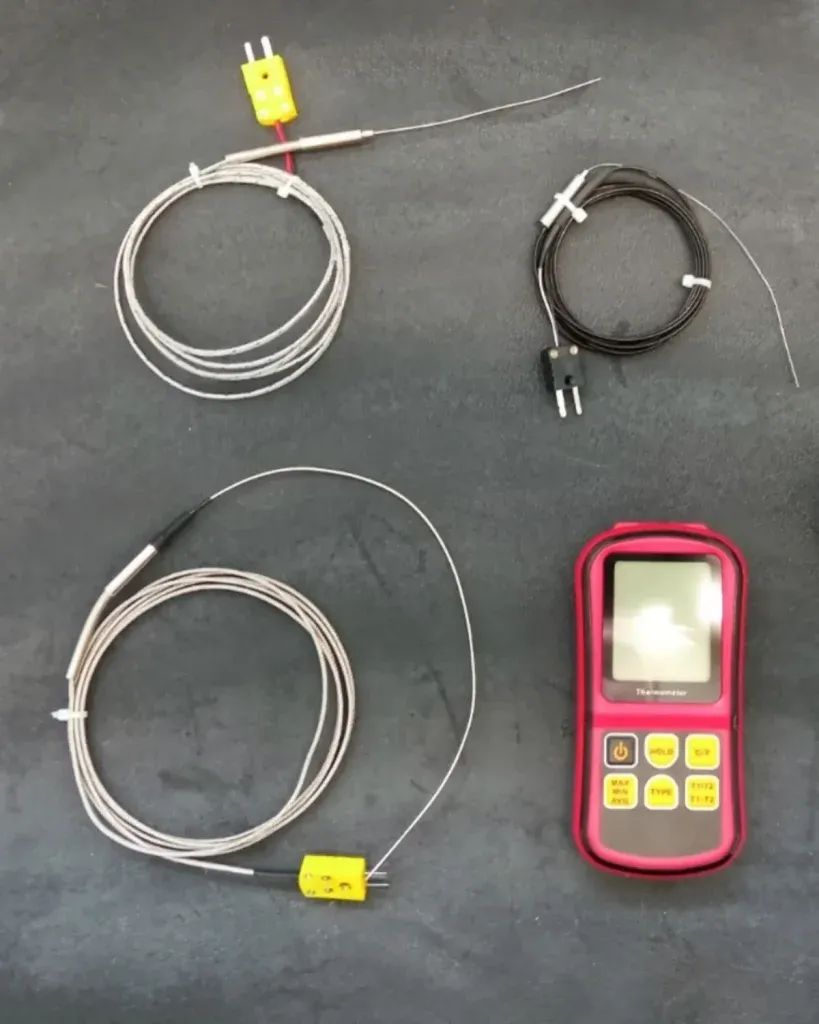
We need 3 thermocouples with different thickness and a thermometer.
The thickness and type of the thermocouples:
- 0,5 mm (J)
- 1 mm (K)
- 1,5 mm (K)
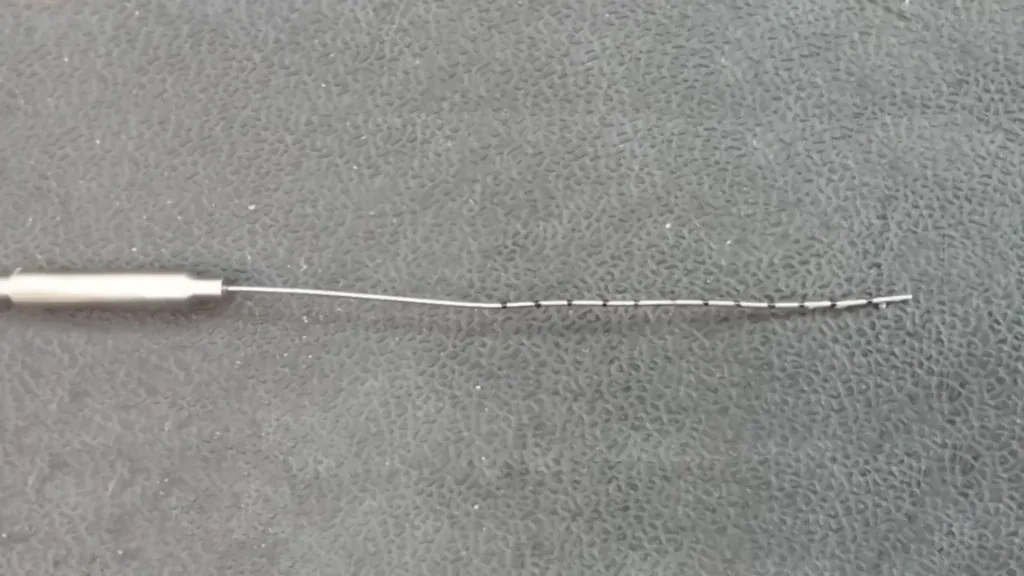
We mark the thermocouples at every 5 mm to see the depth during measurement.
Measurement
During the measurement we start to push in the scaled thermocouple into the heated and dosed cylinder until the first mark.
We wait till the temperature becomes constant and note it.
We push it in until the next mark and repeat the process until we reach the last mark.
We repeat this process at least three times to avoid scatter.
In our case we performed the experiment with three different diameter thermocouples at two different nozzle lengths.
After the measurement with the given nozzle, we change the nozzle to a longer one (or if we started the measurement with longer nozzle then change to shorter) and repeat the measurement.
In our case we changed the 8 mm long nozzle to 16 mm long.
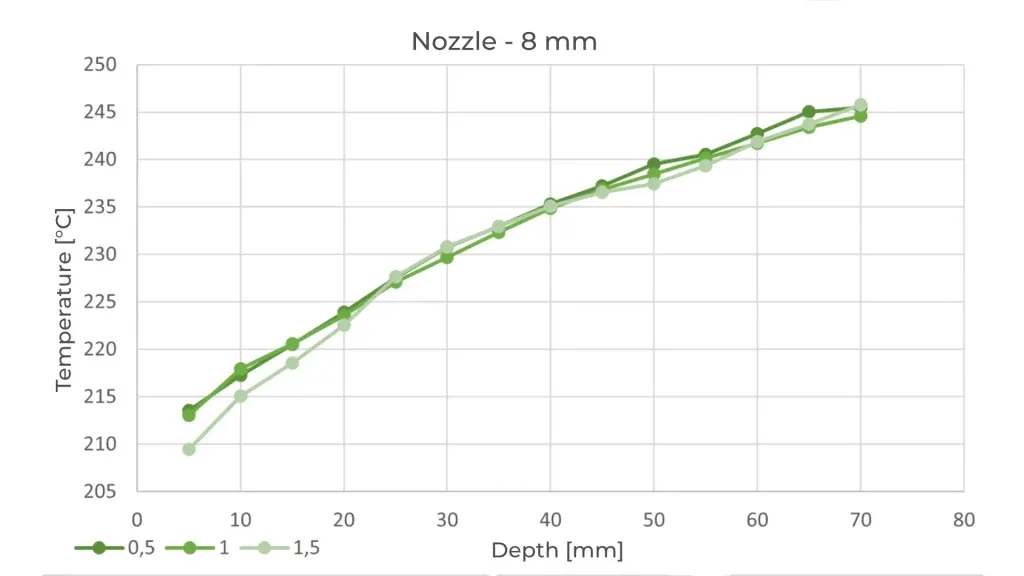
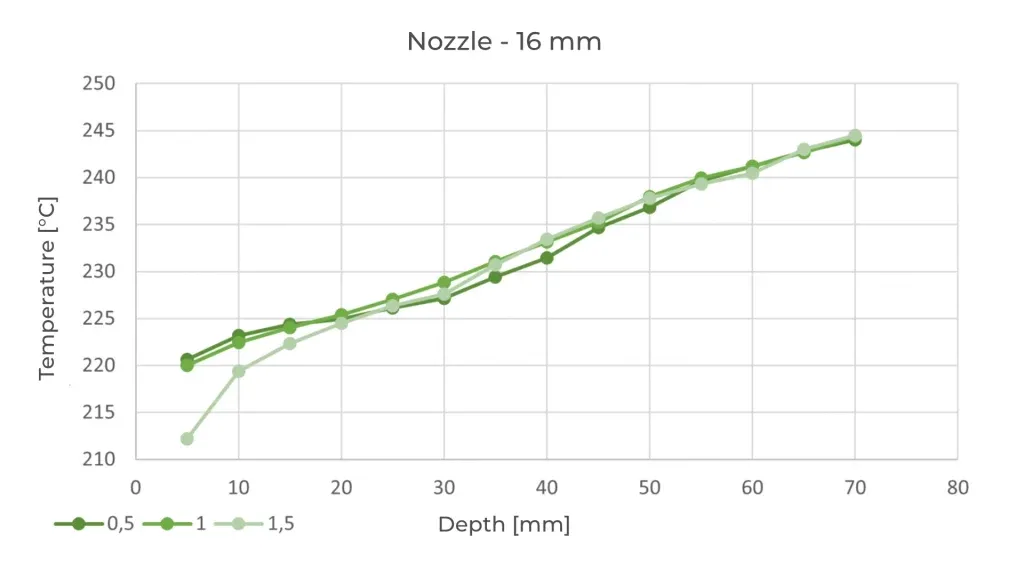
The average of the results:
Conclusion
During measurements even the biggest scatter was under 2%.
The values we got during the measurements in case of the thermocouples with different thickness are nearly the same. And we can say that the difference is lower than 0,5% when the values were measured less than 20 mm inside. Only at the exit section of the nozzles can be detected any difference, in case of the thickest thermocouple and at the longer nozzle it was 13°C.
The exit section of the long nozzle falls farther from the heated zone therefore the room-temperature thick thermocouple is able to cool down the melt.